VAT for Individuals and Small Businesses in the UAE: When It Actually Applies
-
VAT registration becomes mandatory when your taxable supplies exceed AED 375,000 over the past 12 months (or will in the next 30 days); voluntary registration opens at AED 187,500. The test is rolling, not calendar-year.
-
It applies to individuals doing business, not just companies: a freelancer invoicing AED 40,000/month crosses the mandatory line mid-year, and late VAT registration carries its own AED 10,000 penalty.
-
VAT and corporate tax are entirely separate systems that happen to share the number 375,000: VAT's threshold is on revenue and triggers registration; corporate tax's is on profit and sets the 0% band.
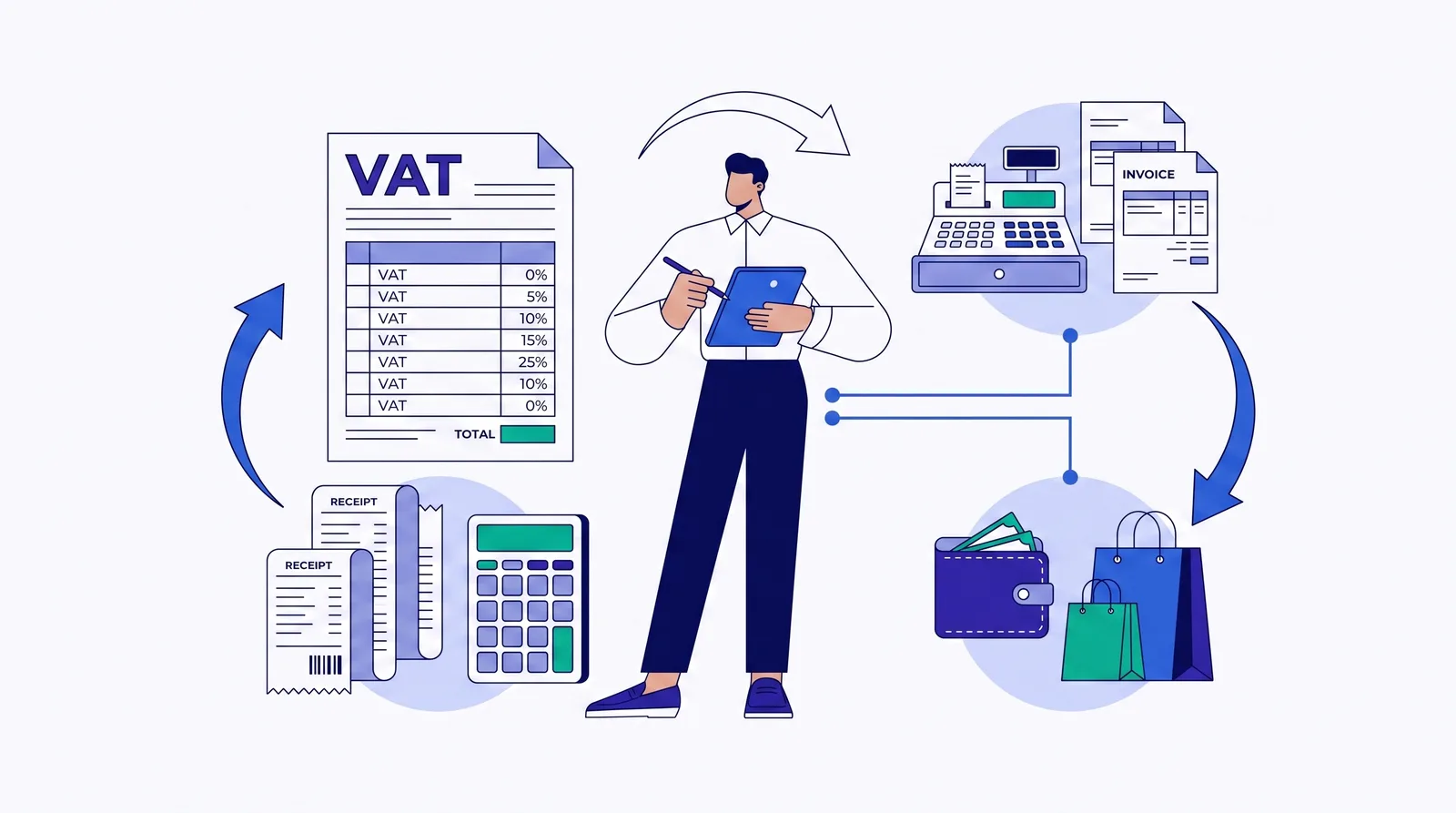
VAT is the tax small UAE businesses actually meet first, usually well before corporate tax matters. Here's when it applies, what it obliges, and how it coexists with the newer regime.
The thresholds, precisely
VAT at 5% has applied since 2018 to supplies of goods and services by businesses, including natural persons conducting business. Registration:
-
Mandatory when taxable supplies (plus imports) exceeded AED 375,000 in the previous 12 months, or are expected to exceed it in the next 30 days. It's a rolling 12-month test checked continuously, not a January-to-December figure.
-
Voluntary from AED 187,500 of taxable supplies or taxable expenses, which is how pre-revenue and early-stage businesses register to reclaim input VAT.
"Taxable supplies" is broad: standard-rated sales, zero-rated sales (exports, certain sectors) count toward the threshold; exempt supplies (bare residential rent, local passenger transport, certain financial services) don't. A freelancer's consulting invoices are taxable supplies; their salary from a day job and personal investment income are not business supplies at all.
What registration obliges
A VAT TRN, tax invoices in the required format, charging 5% on taxable supplies, filing returns (quarterly for most; the FTA assigns the period) within 28 days of each period's end, paying the net (output VAT collected minus input VAT on business costs), and keeping records. The compliance is real but mechanical once invoicing is set up; the failure modes are late registration (AED 10,000), late returns, and treating collected VAT as revenue instead of a liability held for the FTA, which is the classic small-business cash-flow wound.
Should you register voluntarily?
Register early if your customers are VAT-registered businesses (they reclaim what you charge, so your 5% costs them nothing, while you reclaim input VAT on your laptop, software, and rent) or if you're investing ahead of revenue. Hesitate if your customers are consumers, where your price effectively rises 5% against unregistered competitors, and your input VAT is small. Many freelancers sit deliberately in the AED 187,500 to 375,000 band on exactly this logic, but the rolling threshold needs monitoring; crossing it starts a 30-day registration clock.
VAT vs corporate tax: the disambiguation table
| VAT | Corporate tax | |
|---|---|---|
| What's taxed | Transactions (supplies) | Annual profit |
| Rate | 5% | 0% / 9% |
| The 375,000 | Registration threshold, on supplies | 0% band, on taxable income |
| Individual trigger | AED 375,000 supplies (rolling) | AED 1M turnover (calendar year) |
| Registration | Own application, own TRN | Own application, own TRN |
| Returns | Quarterly (typically), 28 days | Annual, 9 months after period end |
The practical consequence: a growing freelancer typically registers for VAT first (at 375,000 of supplies), then for corporate tax later (crossing AED 1 million turnover, per the freelancer rules), and holds two TRNs with two separate filing calendars. Being registered for one does nothing for the other, a trap covered in the EmaraTax registration walkthrough.
Where the systems touch
Revenue for corporate tax purposes (including the AED 3 million Small Business Relief test) is measured excluding VAT: the 5% you collect belongs to the FTA and is neither your revenue nor your profit. And from the compliance side, the FTA increasingly reconciles VAT returns against corporate tax filings, so the two datasets describing your business need to agree; discrepancies are audit bait, with the cost schedule in penalties and deadlines. Clean bookkeeping that tags VAT correctly serves both regimes at once, and the corporate tax rate structure then applies to genuinely comparable numbers.
The quick self-check
Sum your last 12 months of business invoicing (excluding VAT). Over AED 375,000: you should already be VAT-registered. Over AED 187,500 with business customers: voluntary registration is probably free money via input VAT. And separately, if the calendar-year figure passed AED 1 million, the corporate tax obligations attach too; the Small Business Relief Checker covers whether the second one costs you anything through 2026.
Sources and References
-
Federal Decree-Law No. 8 of 2017 on VAT and its Executive Regulation
-
FTA, VAT registration guides and thresholds (tax.gov.ae)
-
Ministerial Decision No. 73 of 2023 (revenue measured excluding VAT for SBR)
This article is general information, not tax advice. Consult a registered tax agent for your specific situation.
Published on 9 September 2026.